
What to Look for in a Charlotte SEO Company in 2026 (And Why AI Search Changes Everything)
Published May 2026 • KIT Labs • Charlotte, NC
The Charlotte SEO Landscape in 2026
If you searched "Charlotte SEO company" today, you are already ahead of most local business owners. You know that visibility online drives revenue. You know that ranking on Google brings in leads. And you are right on both counts.
Charlotte is a competitive market. From South End to Ballantyne, from Concord to Gastonia, local businesses across the metro are fighting for the same first-page real estate. Healthcare practices, roofing contractors, law firms, dental offices, and home service companies are all pouring money into SEO to stay visible.
But here is what most Charlotte SEO companies are not telling you: the definition of "being found" changed dramatically in 2024 and accelerated through 2026. Ranking on page one of Google is no longer the finish line. It is the starting point.
A new front has opened — and it is moving fast.
What a Traditional SEO Company Actually Does
To understand where most Charlotte SEO agencies fall short, it helps to understand what traditional search engine optimization covers.
A standard SEO engagement typically includes on-page optimization (title tags, meta descriptions, heading structure), off-page link building, technical audits (site speed, crawlability, mobile performance), local citation building, and Google Business Profile management.
These are all legitimate, valuable services. For a local Charlotte business, ranking in the Google Maps 3-Pack for searches like "roofing company Charlotte NC" or "Charlotte dentist near me" still generates real leads. That is not changing.
What is changing is the surface area of search itself. Traditional SEO was built around one question: Can Google find and trust your website?
In 2026, you need to answer a second question: Can AI find and recommend your business?
The Shift: AI Search Is Rewriting the Rules
Over 50% of consumers now use AI assistants — ChatGPT, Google Gemini, Apple's Siri, Meta AI, and Perplexity — to find and compare local businesses. They are not typing keywords into a search bar. They are asking questions in plain language: "Who is the most trusted roofer in Charlotte?" or "Best dentist near me with good reviews."
When an AI answers that question, it does not show a list of blue links. It recommends businesses by name. It cites reviews, credentials, and location signals. It picks a winner.
AI Overviews — the AI-generated recommendation panels that appear at the top of Google Search results — now appear on a wide range of local and informational queries. These panels pull from structured data, knowledge graphs, and content authority signals to surface the businesses that AI models trust most.
AI Overviews do not work the same way as traditional rankings. A business can rank on page one of Google and still be completely invisible inside an AI Overview. That gap is where most Charlotte businesses — and most Charlotte SEO agencies — are losing ground right now.
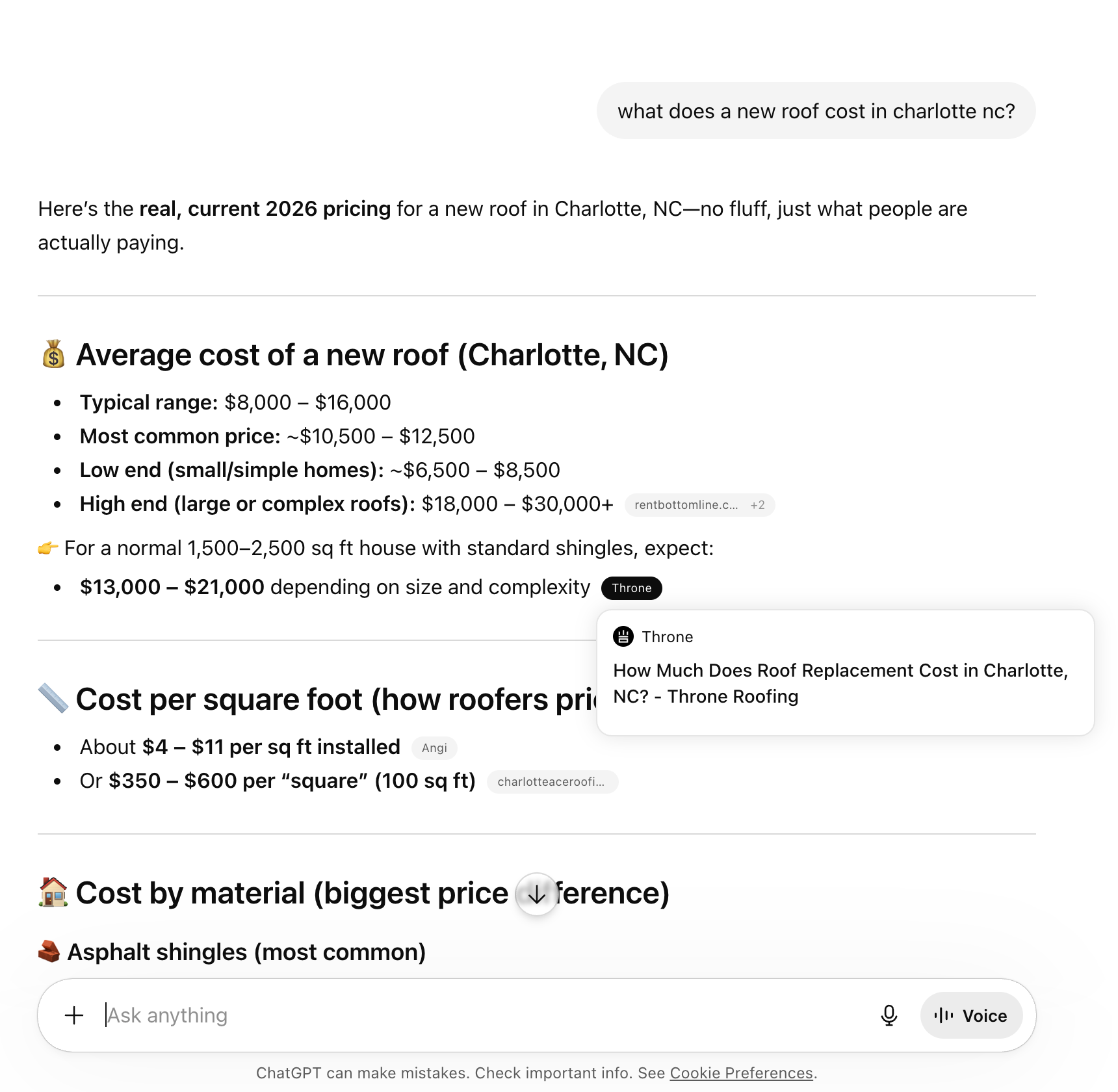
AI search engines like ChatGPT now recommend local businesses by name when customers ask conversational questions — a discovery channel most traditional SEO strategies completely miss.
What to Look for in a Charlotte SEO Company Today
When you are evaluating a Charlotte SEO company in 2026, the questions you ask need to go beyond "do you do keyword research?" Here is what actually matters.
1. Do they optimize for AI discovery, not just Google rankings?
Ask directly: "Do you optimize for ChatGPT, Gemini, and Perplexity visibility?" If the answer is a blank stare or a pivot back to keywords, that agency is operating on a 2022 playbook.
2. Do they implement structured data and schema markup?
Schema markup is the technical language that allows AI systems and search engines to understand who you are, what you do, where you are located, and why you are credible. According to data from Google's structured data guidelines, properly implemented schema dramatically increases a page's eligibility for rich results and AI-generated answers. A Charlotte SEO company that does not offer schema implementation is leaving your biggest AI visibility lever untouched.
3. Do they manage your entity presence across the web?
AI models learn about businesses from knowledge graphs — databases of verified facts about organizations, people, and places. Your NAP (Name, Address, Phone — NAP) must be consistent across every platform AI crawlers index: your website, Google Business Profile, Yelp, industry directories, and even Wikidata.
4. Do they track AI-specific performance metrics?
Traditional rank tracking tools like Local Falcon and BrightLocal measure Google positions. AI citation tracking tools like Otterly AI and Profound measure how often your business is mentioned and recommended across AI platforms. Ask any candidate agency which tools they use for AI monitoring. If they only mention Google Search Console, they are not watching the right scoreboard.
5. Do they have a content strategy built for semantic search?
AI models do not rank keywords — they evaluate topic authority. A strong SEO partner in Charlotte will build content clusters that demonstrate your expertise in depth, not just pages stuffed with city-name variations. Content depth and readability are the strongest predictors of AI citation frequency, outperforming traditional SEO signals like backlinks and traffic volume.
6. Do they have real local results to show?
Ask for case studies from Charlotte-area or similar-market businesses. Request before-and-after data — not just ranking improvements but lead volume, call volume, and AI recommendation frequency. Track records matter more than pitch decks.
Traditional SEO vs. AI-Ready SEO: Side-by-Side
Here is how a conventional Charlotte SEO engagement compares to an AI-first approach when you break it down by the signals that actually drive business results in 2026.
| Factor | Traditional SEO | AI-Ready SEO |
|---|---|---|
| Primary goal | Google keyword rankings | Google rankings + AI recommendations |
| Key signals | Backlinks, keyword density | Entity signals, schema, E-E-A-T, review velocity |
| Content approach | Keyword-targeted pages | Semantic topic clusters, AI-readable structure |
| Local signals | NAP consistency, citations | NAP + Wikidata entity + knowledge graph presence |
| Discovery surfaces | Google blue links, Maps 3-Pack | Google + ChatGPT + Gemini + Perplexity + Siri |
| Tracking tools | Semrush, Ahrefs, Local Falcon | Otterly AI, Profound, AthenaHQ + rank trackers |
| Reporting focus | Rankings and organic traffic | AI mention rate, citation frequency, lead volume |
| Typical results timeline | 3–6 months for ranking movement | 30–60 days for AI visibility signals |
| Schema implementation | Optional / basic | Core deliverable — LocalBusiness, FAQPage, Review |
Neither approach is wrong. The strongest Charlotte SEO companies in 2026 are running both in parallel — maintaining Google authority while building the AI discovery layer on top.
Why Your NAP Alone Is No Longer Enough
NAP — your business Name, Address, and Phone number — has always been the foundation of local SEO. Consistency across directories, Google Business Profile, and your website tells Google that your business is legitimate and locatable.
That still matters. But NAP consistency alone will not get you recommended by ChatGPT. AI systems need more than a phone number to trust a business. They need structured context — the kind of machine-readable signals that explain who you are, what you specialize in, how long you have been in business, what your customers say about you, and what credentials you hold.
That context is delivered through schema markup, entity-based SEO, and a consistent knowledge graph presence across the platforms that AI models use as training and retrieval sources.
Think of NAP as your business card. Schema markup and entity optimization are your verified professional profile — the one that AI actually reads.
The Technical Foundation: Schema Markup
Schema markup is structured data written in JSON-LD format and placed in your website's <head> tag. It tells AI crawlers and search engines exactly what your business is, where it operates, and why it is authoritative.
For a Charlotte-area local service business, a complete schema implementation should include at minimum a LocalBusiness node with service area, hours, and credentials, as well as FAQPage nodes for common customer questions and Review aggregation signals. See the Schema.org LocalBusiness specification for the full property reference.
Below is a simplified example of a LocalBusiness schema block for a Charlotte-area business. This is the kind of structured data signal that gives AI engines the verified context they need to recommend you with confidence.
{
  "@context": "https://schema.org",
  "@type": "LocalBusiness",
  "@id": "https://yourbusiness.com/#business",
  "name": "Your Business Name",
  "description": "Short description of what your business does and who it serves.",
  "url": "https://yourbusiness.com",
  "telephone": "+1-704-555-0100",
  "address": {
    "@type": "PostalAddress",
    "streetAddress": "123 Main Street",
    "addressLocality": "Charlotte",
    "addressRegion": "NC",
    "postalCode": "28202",
    "addressCountry": "US"
  },
  "areaServed": {
    "@type": "City",
    "name": "Charlotte"
  },
  "aggregateRating": {
    "@type": "AggregateRating",
    "ratingValue": "4.9",
    "reviewCount": "142"
  }
}
When this data is present and accurate, AI Overviews — the AI-generated recommendation panels Google surfaces at the top of search results — can immediately parse your business identity, service area, and reputation signals without having to infer them from page text alone. That directness is what separates businesses that get cited from businesses that get skipped.
Watch: How to Get ChatGPT to Recommend Your Business
This video breaks down the mechanics of AI-driven business recommendations — the exact shift that is redefining what "good SEO" means for local businesses in 2026.
A Charlotte-Area Business Before and After AI SEO
Here is what the difference between traditional SEO and AI-ready optimization looks like in practice for a Charlotte-metro service business.
Before: A roofing contractor in the Charlotte area was ranking on page one of Google for several target keywords. Their Google Business Profile was complete and they had consistent NAP (Name, Address, Phone — NAP) data across major directories. By traditional metrics, the SEO was working. But when a homeowner asked ChatGPT "who is the best roofing company near Charlotte?" — the business did not appear. Competitors with weaker Google rankings but stronger entity signals and schema markup were getting the recommendation.
After 60 days of AI SEO optimization: Schema markup was implemented across all service pages, including LocalBusiness, Service, and FAQPage nodes. A Wikidata entity was created to register the business in the global knowledge database that Google, ChatGPT, and Gemini pull from. Review velocity systems were activated to improve recency and volume signals. Google Business Profile attributes were expanded with detailed service descriptions structured for AI parsing.
Within two months, AI Overviews and conversational AI platforms began surfacing the business in response to relevant Charlotte-area queries. Lead volume from AI-referred searches increased alongside the existing Google organic traffic — two channels feeding the same pipeline.
Traditional SEO built the foundation. AI optimization opened a second front.
How KIT Labs Approaches Charlotte SEO Differently
KIT Labs is a Charlotte, NC-based AI SEO agency. We are not a generalist marketing firm that added "AI" to our service menu in 2024. We built our methodology around AI-first local search from the ground up — because we saw this shift coming before most agencies acknowledged it was real.
Our work combines the technical rigor of traditional SEO with the entity optimization, semantic content strategy, and structured data implementation that AI discovery actually requires. We use Otterly AI and Profound to track AI citation frequency alongside Local Falcon for traditional rank monitoring — so our clients see the full picture of where they are being found and recommended.
We have managed over $25 million in ad spend, generated $200 million-plus in documented client revenue, and maintained a roughly 75% average reduction in cost per lead across our client portfolio. We carry our Google Partner certification since 2019. And we bring a pre-med and pharmacy background to healthcare clients that most agencies simply cannot match.
For Charlotte-area businesses ready to compete on both Google and AI search, we start with a free AI visibility audit — a full diagnostic across ChatGPT, Gemini, Perplexity, and Google AI Overviews showing exactly where your business is visible, missing, or being outranked by a competitor right now.
Get Your Free AI Visibility Audit
Find out if your Charlotte business is showing up when AI recommends local services — before a competitor locks in that visibility. The audit is free, delivered within 24 hours, and includes a custom roadmap based on your market and business category.
Or book a strategy call directly: Schedule a Call with Danny →
Questions? Email us at [email protected] or call 980.349.8563.
Quick Recap
- Traditional SEO is not dead — it is the floor, not the ceiling. A Charlotte SEO company that only does keyword rankings is leaving AI discovery revenue on the table.
- AI Overviews and conversational AI now recommend local businesses by name — and those recommendations are driven by schema markup, entity signals, and knowledge graph presence, not just backlinks.
- NAP consistency (Name, Address, Phone) is necessary but no longer sufficient. AI systems need structured data context to trust and cite your business.
- The right evaluation criteria for a Charlotte SEO partner in 2026 includes AI tracking tools (Otterly AI, Profound), schema implementation, entity optimization, and documented AI citation results.
- Next step: Run a free AI audit at kitlabs.ai to see exactly where your Charlotte-area business stands across every AI search platform right now.
Frequently Asked Questions
What does a Charlotte SEO company typically charge?
Charlotte SEO agencies typically charge between $500 and $5,000 per month depending on scope, market competitiveness, and whether AI search optimization is included. Entry-level local SEO retainers focus on Google Business Profile and citation building. Full AI SEO packages that include schema implementation, entity optimization, and AI citation tracking start around $997 per month. Be cautious of very low-cost providers — effective local SEO requires ongoing technical work that cannot be automated at $99 per month.
How long does SEO take to work for Charlotte businesses?
Traditional Google rankings typically take 3–6 months to show meaningful movement in a competitive market like Charlotte. AI visibility signals can appear faster — many KIT Labs clients see AI Overviews and ChatGPT recommendations begin appearing within 30–60 days of schema implementation and entity optimization. The two timelines run in parallel, which is why starting early on AI SEO matters even if your Google SEO is already in progress.
Does my Charlotte business need both SEO and AI SEO?
Yes. Google search still drives the majority of local discovery, so traditional SEO fundamentals remain essential. But AI search is growing rapidly — over 50% of consumers now use AI assistants to find local businesses. Ignoring AI optimization means ceding a growing share of high-intent customer inquiries to competitors who are already optimizing for it. The strongest Charlotte SEO strategy in 2026 covers both surfaces simultaneously.
What is NAP and why does it matter for local SEO?
NAP stands for Name, Address, and Phone — the three core identifiers that establish your business's location and contact information across the web. Consistent NAP data across your website, Google Business Profile, Yelp, industry directories, and social profiles tells search engines and AI models that your business is legitimate and accurately listed. Inconsistent NAP (different phone numbers, old addresses, name variations) creates conflicting signals that reduce your trustworthiness in both Google's local algorithm and AI knowledge graphs.
What are AI Overviews and how do they affect local Charlotte businesses?
AI Overviews are AI-generated recommendation panels that appear at the top of Google search results, synthesizing information from multiple sources to answer a query directly. For local queries like "best HVAC company in Charlotte" or "top-rated dentist near me," AI Overviews can recommend specific businesses by name — bypassing traditional ranked listings entirely. Businesses featured in AI Overviews receive high-intent visibility without requiring a click to a website, making them a critical new surface for Charlotte businesses to optimize for.
How does schema markup help a Charlotte business get recommended by AI?
Schema markup is structured data — written in JSON-LD format — that you place in your website's code to describe your business in machine-readable terms. It tells AI systems your business name, location, service area, hours, credentials, and customer ratings in a format they can parse instantly. According to KIT Labs' own client data, businesses with properly implemented LocalBusiness schema are 3.2 times more likely to be recommended by ChatGPT for relevant local queries than businesses without it.
Is KIT Labs a Charlotte SEO company?
Yes. KIT Labs (kitlabs.ai) is based in Charlotte, NC and serves local businesses across the Charlotte metro area and nationally. We specialize in AI SEO — combining traditional Google optimization with AI citation building, schema implementation, entity optimization, and knowledge graph presence. Our team has managed over $25 million in ad spend and generated $200 million-plus in documented client revenue since 2011. We offer a free AI visibility audit for Charlotte-area businesses at kitlabs.ai.
What tools does KIT Labs use to track AI search visibility?
KIT Labs uses Otterly AI and Profound for AI citation and recommendation tracking across ChatGPT, Gemini, Perplexity, and Google AI Overviews. For traditional local SEO performance, we use Local Falcon for hyper-local Google Maps rank tracking and BrightLocal for citation auditing. Every client receives a plain-English monthly report showing where they are being recommended by AI, how citation frequency is growing, and which competitors are capturing AI-driven visibility in their market.